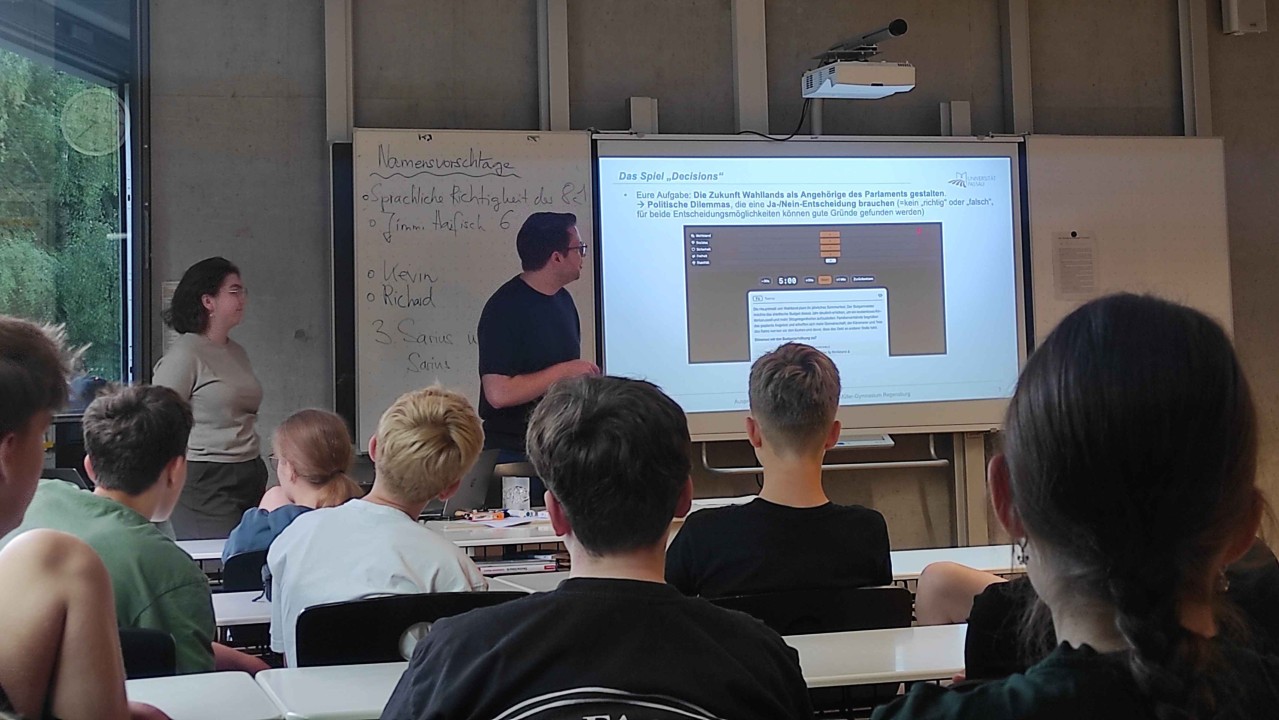
Students playing “Decisions” at Von-Müller-Gymnasium in Regensburg; photo: Anton-Claudio Schäfer.
How can young people’s competencies be strengthened so that disinformation and conspiracy narratives don’t take hold?
The TaCT-FoRSED project at the Centre for Teacher Education and Subject Didactics (ZLF) at the University of Passau takes a playful approach: the team led by Dr. Hannes Birnkammerer and Patrick Urlbauer tested two games they developed themselves together with teachers and their classes at Gymnasium Leopoldinum in Passau and Von-Müller-Gymnasium in Regensburg.
Two of the project’s own games were tested. In “Headline Hunter,” students act as “Headliners” and write a headline of their own that blends in as inconspicuously as possible with a series of other headlines by deliberately imitating their style. The “Hunters” have to work out which headline was written by their classmates. In the process, learners analyze how headlines balance credibility and drama, and develop a feel for sensationalist exaggeration and manipulative stylistic devices, which disinformation also relies on.
In “Decisions,” the young people take on the roles of parties in the parliament of a fictional country and negotiate real-world political dilemmas in the areas of the environment, migration, and digital sovereignty. There are no “right” answers: every decision has consequences and creates new dilemmas, while at the same time the social cohesion of the fictional country must not be squandered.
”Both games target exactly those competencies that make people resilient against conspiracy narratives.
Hannes BirnkammererTaCT-FoRSED coordinator
“Headline Hunter trains a critical, reflective approach to news: healthy skepticism instead of blanket distrust. And Decisions lets young people experience that in a democracy there are legitimate differing perspectives and that their own voice makes a difference, even if compromises sometimes have to be made. In this way, the games lay the groundwork for the competency clusters that we describe in the project as democratic resilience, democratic identity, and democratic self-efficacy.”
What sets the Passau approach apart is the close integration of school practice and research: teachers and project staff planned the classroom use together in an on-site workshop and then taught the lessons jointly. “Teachers are the specialists in teaching; we bring the research on game-based learning and the games,” says Patrick Urlbauer, research associate on the project. “Shaping the lessons together, from planning through delivery, was a benefit for both sides: we learn directly whether our materials fit curricula and everyday school life, and the feedback from teachers and their classes feeds straight into the next version of the games. In our view, collaboration can’t work any better than this.”
”I was glad to be able to try this out with my class and offer my students something different. They were in the game right away.
Anton-Claudio SchäferTeacher, Politics and Society
The participating teachers also draw a positive conclusion: “I was glad to be able to try this out with my class and offer my students something different. They were in the game right away. For a first practical test, it went really well. And in the debrief with the project team, we collected many ideas for how the game and its integration into lessons can be improved even further,” says Anton-Claudio Schäfer (Politics and Society, Von-Müller-Gymnasium).
The tested games, revised on the basis of the feedback, will be released as freely usable Open Educational Resources, together with teaching materials, in TaCT-ForSED’s Digital Game Box.
With the new school year, the project team is also opening its teacher community Europe-wide: interested teachers can join the “Games for Democracy” network, use the games in their own classes, and take part in regular digital exchange formats. The project also offers schools on-site sessions or a “School at the University” format, as well as expert talks on the game topics and on game-based learning.
“We are always interested in further collaborations,” Patrick Urlbauer sums up. “We think we can offer schools an exciting program, which we would like to keep refining in cooperation with them.”